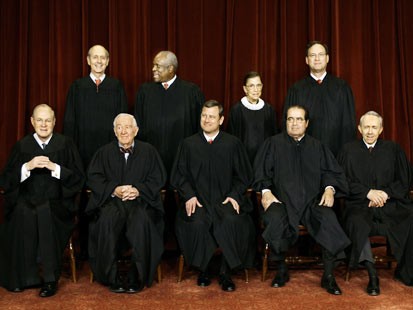
For the next 3 decades the court avoided addressing the question of whether restrictions on union and corporate expenditures imposed by the Labor Management Relations Act were constitutional. When cases came up, rather than addressing the constitutionality of the Act, they instead narrowly interpreted the Act in ways that most forms of corporate political speech were not prohibited. After one such ruling in United States v. Automobile Workers, the dissenting minority argued that the constitutional question should have been addressed:
“Under our Constitution it is We The People who are sovereign. The people have the final say. The legislators are their spokesmen. The people determine through their votes the destiny of the nation. It is therefore important—vitally important—that all channels of communications be open to them during every election, that no point of view be restrained or barred, and that the people have access to the views of every group in the community.”
The dissenters concluded that deeming a particular group “too powerful” was not a “justification for withholding First Amendment rights from any group—labor or corporate.” (It is interesting to note that CJ Warren, the infamous 'ultra-liberal' judge, was among the dissenting justices)
In 1971, Congress passed an FEC Act that imposed new independent expenditure limits on Corporations, Unions, and individuals. This Act was challenged in Buckley v. Valeo and the court invalidated the independent expenditure restrictions. In the decision, they approvingly cited the dissenting opinion expressed in the earlier Automobile Workers case. Later, the Bellotti court upheld the Buckley decision when it struck down a state-law prohibition on corporate independent expenditures related to referenda issues:
“We thus find no support in the First . . . Amendment, or in the decisions of this Court, for the proposition that speech that otherwise would be within the protection of the First Amendment loses that protection simply because its source is a corporation that cannot prove, to the satisfaction of a court, a material effect on its business or property. . . . [That proposition] amounts to an impermissible legislative prohibition of speech based on the identity of the interests that spokesmen may represent in public debate over controversial issues and a requirement that the speaker have a sufficiently great interest in the subject to justify communication. In the realm of protected speech, the legislature is constitutionally disqualified from dictating the subjects about which persons may speak and the speakers who may address a public issue.”
Quoting from the current decision:
"Thus the law stood until Austin. Austin “upheld a direct restriction on the independent expenditure of funds for political speech for the first time in [this Court’s] history. There, the Michigan Chamber of Commerce sought to use general treasury funds to run a newspaper ad supporting a specific candidate. Michigan law, however, prohibited corporate independent expenditures that supported or opposed any candidate for state office. A violation of the law was punishable as a felony. The Court sustained the speech prohibition. To bypass Buckley and Bellotti, the Austin Court identified a new governmental interest in limiting political speech: an antidistortion interest. Austin found a compelling governmental interest in preventing “the corrosive and distorting effects of immense aggregations of wealth that are accumulated with the help of the corporate form and that have little or no correlation to the public’s support for the corporation’s political ideas...The Court is thus confronted with conflicting lines of precedent: a pre-Austin line that forbids restrictions on political speech based on the speaker’s corporate identity and a post-Austin line that permits them."
So the Supreme Court has decided to settle the matter once and for all. In doing so they have come down on the side of a strict reading of the constitution, and on the side of the corporations. I think they made the right decision (following the logic of the constitution). In fact, it seems that those who argue against the decision are forced to base their arguments on premises that are necessarily distinct from the text, and any reasonable interpretation of the constitution (aka J Stevens). But, having said that...
It is interesting to note that the Courts have historically drawn a clear legal distinction between direct contributions to politicians (which ARE limited because of the potential for political quid pro quo), and independent expenditures in support of politicians. I understand the technical distinction, but is there really any distinction in effect? Is it not just as likely that a corporation will spend funds "independently" in ways that the politician would have spent the money if it were given to him directly? In fact, I can imagine a corporation calling a politician and asking, "Hey scumbag politician, how do you want me to spend this money to help you win?" And all of this in exchange for future benefits. Is the potential for political quid pro quo any less in the 'independent' expenditure case? Are we not all screwed either way?
What we really need are politicians who can not be bought for any price, in any way, directly, indirectly...whatever. To get that type of politician we need to be a people that is unwilling to be bought by our elected leaders at any price. We are coming up short I am afraid.


 Posts
Posts


No comments:
Post a Comment